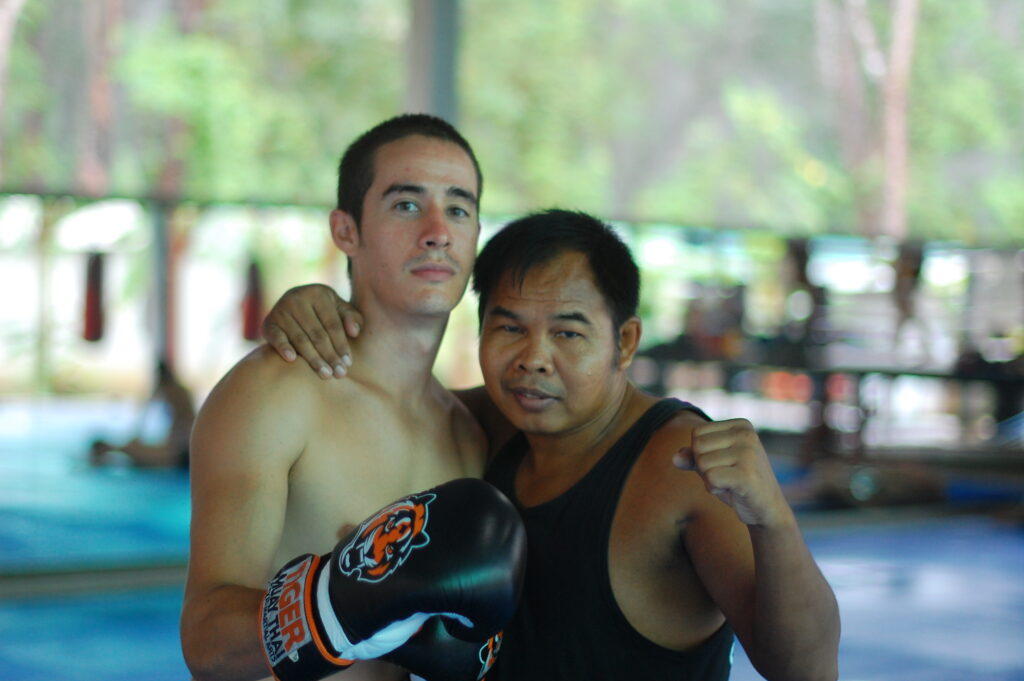
Muay Thai Training Camp, Phuket Thailand
One day I bump into Roberto as I’m leaving the apartment. Roberto’s my only neighbor in the non-descript duplex apartment at the end of the road. He’s a six-foot-two wiry Italian man in his mid-30s, and I’ve seen him training two sessions a day since I arrived.
Once, after a tough morning session, he told me he’d come with the intention of fighting in Thailand, but that he has no delusions about making a career out of it. He works construction back in Italy. He’s old for a fighter. He has other dreams. But this, fight in Thailand as a Muay Thai fighter — and to win! — he wants this for himself.
“Nate! Where are you headed?” he asks. “Want to come to Western Boxing with me? You know Chokchai?”
“I do. Nice guy. He’s a boxer?”
Turns out Chokchai wasn’t just a famous Muay Thai fighter, he was a world-class boxer. His claim to fame, besides a 39–5 (19 KO’s) record as a flyweight, is that he lost his Oriental flyweight boxing title to the much younger Filipino boxer, Manny Pacquiao in 1997 in Manila, Philippines. At the time, Chokchai was favored to win. And Manny, though his talent and potential must have been well-known to some people, was still a 20-year-old kid unknown to the world.
For the first five rounds, Chokchai was winning the fight, although it would have been close to call. But in the fifth round, an untimely duck brought Chokchai’s forehead and a ferocious Pacquiao left-uppercut into the same space, and well — there wasn’t any room for the forehead.
Now Pacquiao is a multi-millionaire and has been a senator in the Philippines. He’s had a career that ranks him №2 on the list of top pound-for-pound boxers of all time, according to ESPN.
And Chokchai is stuck trying to teach me how to throw a jab.
Chokchai is sitting on a tire joking with another trainer when we arrive at the ring for Western boxing. He greets us with a warm smile and hello, then offers to tie my hand wraps. As he takes the long yellow cotton wraps and weaves them between my fingers and around my wrists with the expertise of a man who’s performed this ritual thousands of times, I can’t help but think about how he traded blows with Manny Pacquiao.
But Chokchai seems just as intrigued by me, and as he works on the wraps, he asks me questions: Where are you from? How long are you here? Why do you want to box?
Once the wraps are secure, he stands up and tells me to warm up on the rubber tire he was sitting on. There are tractor-size tires stationed on the outskirts of almost every section of the camp. To warm up, you spread your legs wide in an exaggerated fighter’s stance and jump lightly on the inside ring while twisting your body back and forth and shadowboxing. It loosens the muscles in your legs and gets you up on your toes, ready to spring forward, backward, or side-to-side as needed. This is what Chockchai meant the first day when he said it’s “like dancing.” He wanted me to loosen up and be the butterfly, not the bee.
As I dance around the tire, Chokchai turns to Roberto who is tying his own wraps and slaps him on the back good-naturedly.
“Roberto!” he says. “How are you today?”
Then we jump rope. In high school, I used to jump rope almost every day to improve my foot speed for basketball, so unlike everything else at Tiger Muay Thai, I’m comfortable doing it.
Then we jog in circles around the ring as Chokchai yells out; “Uppacut! — Jab! — Hook! — Uppacut-jab-jab-hook! — Uppacut-jab-jab-hook!”
Next comes pad work. One of the trainers (there are four trainers to about 12 students) holds up pads that fit over his hands like baseball mitts and directs you on how to punch. To begin, he vocalizes commands and holds his pad firm in the appropriate position —
“Left Jab! Right hook!”
As I get the hang of it, he moves his hands to certain positions, and you throw the appropriate blows. It’s all done with precise timing — at least when it’s done well.
At first, my punches snap and pop when they hit the pads. But pad work is exhausting. Two minutes into the drill and my punches slide softly into the mitts like a toddler turning into his pillow after he tires of a temper tantrum. I punch the way the early morning breeze rustles the banana leaves.
A quick water break, but at least Chokchai isn’t threatening to hit us with a stick if we forget to bring water. Then, the gloves go back on and we spend three minutes (one round of Western boxing) with the heavy bag.
By now the muscles in my shoulders and back have passed exhaustion and have nearly gone to sleep — JAB! — a few remnants of strength remaining — “HOOK!” — I feel like I’m boxing a marble statue — “UPPACUT!” — now the bag, which before the workout was swaying in the wind, is damn-near immovable.
As we work, Chokchai smiles and gives advice, corrects our mistakes, demonstrates proper technique, and when the moment calls for it, makes a joke. He radiates the energy of a man who loves his job — not of a man who was knocked out by one of the best boxers in the world, which for some reason, is all I can think about.
I lean my sweat-glazed forehead against the bag and swing uninspired hooks into its belly like a four-year-old at the end of a tantrum.
“Gloves on! Now we spar!” Chokchai shouts with a mischievous grin on his face.
She’s been boxing since she was eight and next summer, she’s headed to the Olympics to fight for Scotland. I’ve been boxing for about an hour and next summer, I’m headed to Paris to drink wine and look at art.
She bobs, weaves, hooks, jabs, and does all sorts of things I don’t know how to counter or do myself. I throw a clumsy jab. She throws a tight combination. She can’t weigh more than 120 pounds, but after a quick left jab snaps above my left eyebrow, it’s clear it doesn’t matter how big she is — she’s not messing around.
If I had to fight this girl for real, my best bet would be to grab her in a big bear hug and throw her to the ground. Maybe pick up a broomstick and whack her across the head with it. But since we’re sparring in a ring with trainers watching, I can’t resort to those measures. And she really knows how to box!
So instead, I keep my hands up in defense and do what I can, which at this point in my training, isn’t much. A few jabs here, some sidestepping, a few more jabs followed by a slow, lumbering hook.
But it seems that after every punch I throw she hits me with two, and by the end of the round, the only round (thank goodness), my head’s pounding and I’ve lost a contact lens.
As I walk to the side of the ring, she touches me on the elbow with her gloved hand — “Ey,” she says in a thick Scottish accent.
“Effery time you jab, ya drop ya gua’d. And thaat’s won I hit chuu. Keep ya ahms up.”
I thank her for the advice, noticing my sore jaw when I talk and walk away.
Thank you for reading. This is an excerpt from my first book “The Renaissance Man Project: A Search for meaning through martial arts, poetry, music, dance, art, and philosophy.” It will be available for purchase here on Amazon on January 15, 2025.