An excerpt from ‘The Renaissance Man Project’
The head trainer of the beginner Muay Thai class is a Thai man in his mid-40s named Dang who jokingly calls himself “Mr. Miyagi.” He carries a long thin stick he uses to smack the other trainers and sometimes the students who are having trouble keeping up with the workout. His blows aren’t malicious or intended to cause pain, but it doesn’t take long to realize Mr. Miyagi has a unique and somewhat sadistic sense of humor.
Sometimes, he lets loose a solid whack or kicks one of the younger trainers in the ass if they don’t follow his directions or are slow to demonstrate a technique, and he seems to derive a great deal of pleasure from making them wince. In a way, his goofing lightens the mood of the training, but it also reinforces his position as the eldest, head trainer — the man with the stick.
One look at Mr. Miyagi and you can tell he was a fighter. He has a cauliflower ear, and his left knee is scarred and about two inches off center. He sports a bald head and a thick goatee and is stockier than the other trainers. He’s no longer in fighting shape, but there are traces of definition in his arms and legs. He also gives off pirate vibes. As he yells at us to get ready for warm-ups, his voice crackles like dried leaves. I imagine him climbing a rope onto the stern of a ship, equipped with a bandana, sword, and gold tooth, and forcefully demanding the captain hand over the booty.
“Don’t forget to bring water. I hit you with stick!” he shouts with a sly grin as we spread out on the mats to stretch.
After stretching, we form a large circle and jog. While we jog, we are told to keep our hands up in a boxer stance and throw punches.
“Left jab! Right jab! Left uppercut! Right uppercut! Left hook!” he shouts from outside the circle, and the large sweaty group of barefoot fighters obeys.
Afterward, we begin a group exercise that focuses on form. We are spaced out about three feet apart, facing the long row of mirrors that line the front of the workout space. Again, Mr. Miyagi shouts commands, this time from the front, and one of the younger trainers demonstrates the proper form — “Right jab! Left uppercut! Block! Right kick! Block!”
It must be obvious that I don’t know what I’m doing because as soon as I get in my stance a trainer pulls me aside.
The trainer’s name is Chokchai, a short, almost pudgy, baby-faced man in his late 30s with a goofy smile. Unlike Mr. Miyagi, whose demeanor is aggressive, Chokchai gives off a friendly, happy vibe.
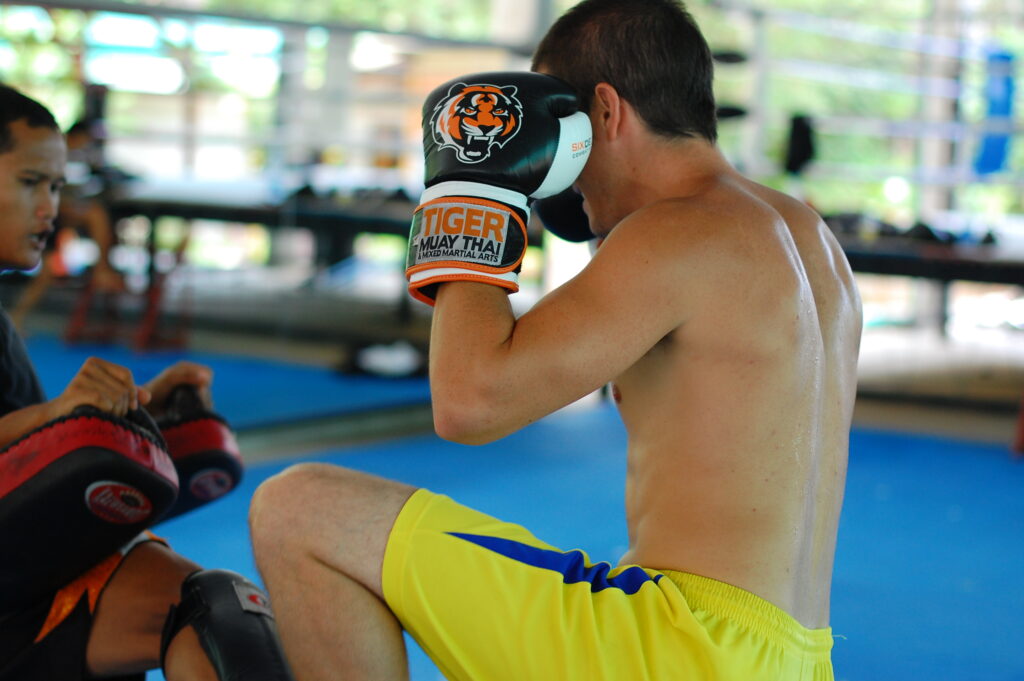
First Chokchai shows me how to stand correctly. He lightly touches my shoulders and adjusts them so that they are nearly squared to my opponent, and not sharply angled like a boxer. Next, he adjusts my feet until my right foot’s toes are in line with my left foot’s heel, and all my toes point straight ahead at the opponent.
The stance feels awkward. In western boxing, the only style of fighting I’d been exposed to, the back foot is significantly behind the front, enabling quick jabs from the off-hand and powerful overhands and hooks from the fighter’s strong arm. The wider stance also makes it easier to balance and move. But in Muay Thai, the stance is not designed to maximize and protect against attacks from kicks and knees.
Finally, he raises my elbows so that my fists are up by my temples, blocking my face and head. Before his assistance, I was holding my fists down by my chin, leaving half of my head open to attack.
By the time I’m set in my stance, I’m stiff as a tree, and Chokchai lets loose a boisterous laugh.
“Calm,” he says, smiling. “Relax. Relax.”
He walks behind me and massages my shoulders briefly. But I can’t relax and at the same time feel ready. I am tense in my mind, and it is manifesting in my body.
“Now kick!”
I heave my right leg forward in my best attempt to mimic every fighting movie I’ve ever seen from Karate Kid to Bloodsport, but the resulting blow wouldn’t knock dust off the bag.
“Again!”
Not much better.
Chokchai smiles. “Okay stop. Lift leg.”
I raise my right leg, and he grabs hold of my knee and thigh. He twists it at a 90-degree angle so my shin faces the bag.
“Like this!” he shouts, “Bang!” But my hips are not flexible; they burn when they bend. “You strike here,” he says, touching the arch of my foot.
Chokchai helps me with my form for about 15 minutes, and then the group is divided up and given partners to spar with. I’m paired off with a Canadian girl with thick, muscular legs who has been training at Tiger for over two months. We tie our hand wraps with the assistance of the trainers, then put on our gloves and shin pads that awkwardly cover the tops of our feet up to just below the knee. She wears a tight black tank top soaked through with sweat. I am in shorts. We are both barefoot.
As we begin to spar, I notice the shin pads are too big for me, and I need to keep adjusting them or they flap loose around my feet.
And my kicks, without Chokchai there guiding me, are slow and awkward. I possess neither the flexibility nor the technique to make them snap. After I kick, I often lose balance and spin around 360 to regain my stance — a perfect opportunity for my opponent to kick me in the back, head, stomach, or face.
The loose leg pad complicates my already awkward dance, and the Canadian, sound in her form, blocks my attacks with ease, calmly raising her muscular leg at the knee to form a shin shield that protects her torso and deflects my clumsy kicks.
She knows what she’s doing, and I don’t have a clue. When my leg limbos, caught in no man’s land between attack and protect, she attacks — her powerful thigh twists and her leg comes slicing at my ribs or thighs before I have time to block.
Thank you for reading. This is an excerpt from my first non-fiction book “The Renaissance Man Project.” It is available for pre-order here on Kindle. Physical books will be available on January 15th, 2024.