Photo by Diego Lozano on Unsplash
Zacatecas, Mexico
On the last night of the “Rosario,” there are over 100 people and eight or nine dogs at Doña Julia’s house — a humble, two-story adobe building painted the color of ripe papaya with lavender trim tucked away on a steep alleywaytypical of Zacatecas city.
The house is full, and the spill-over sits outside on the alleyway steps and in fold-up chairs put out by the family. The people are old and young — from babies to octogenarians. A few must be carried up steps in wheelchairs, while others with walkers are assisted by their grown-up children. The actual children run circles and play soccer atop the alleyway. Others sit on their mother’s lap and listen to the prayers.
Tonight is the final night of the Rosario, a Mexican Catholic tradition where friends and family gather to pray for the safe passage of the deceased for nine consecutive nights. Each day, the Rosario has grown in numbers, and each day the people seem a little less sad — no, not that — but something in them feels stronger and sturdier.
The prayers, called the Mysteries, are repeated, again and again, rhythmic incantations to Mary and Jesus — the same woman tucked into the far corner reciting the first half of the prayer, and the rest of us replying with the second verse.
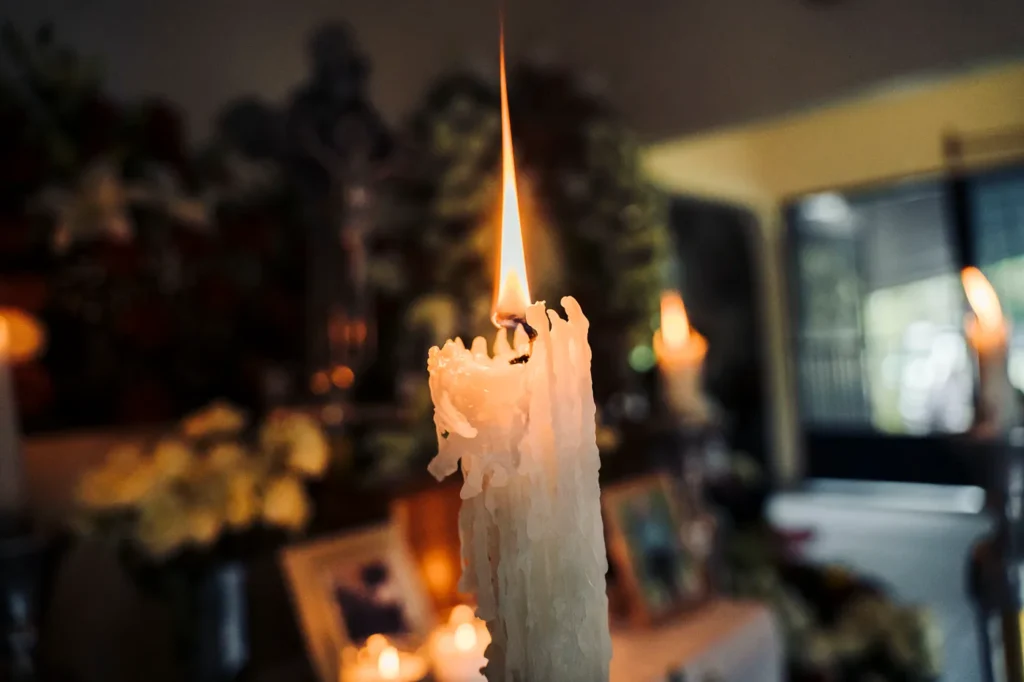
Tonight, a man plays an electric keyboard and sings in a soft but sure voice that carries onto the street. Two white candles flicker on the floor in front of a blown-up picture of Julia propped onto a table decorated with flowers and more candles. Some days, like tonight, there have been musicians, but most nights, we sing and pray with only our voices. Every night, a different family member passes out food when the prayers conclude.
In the alleyway, the aunts and uncles light cigarettes and inhale deeply. Their eyes are bloodshot and swell with tears as they stare into nothingness. The balcony of the second floor where Julia slept and where I met her and she asked me and my wife, who was my girlfriend at the time, “When are you going to get married and have kids?” — is crowded with plants. A few of them are in bloom.
For a moment, I watch my wife leaning in the doorway and realize her skin is the color of Zacatecas — pink limestone and purple sunset — a remarkably beautiful desert flower. I stop to write, then look up, and she is gone, having entered the house of prayer.
The living room overflows with neighbors and friends, but mostly it is the sons, daughters, grandsons, and great-grandsons of the deceased. Doña Julia was my wife’s last remaining grandparent. She had eight children — one of which was my wife’s father, who she has now joined in the graveyard of Tres Cruces — the working-class neighborhood of Zacatecas where my wife grew up.
Seven of her children had children of their own, making Doña Julia not just the respected matriarch of a family but practically of an entire community.Now, three generations come together to mourn the loss of the woman who gave them life and lived to be ninety-eight years old.
From the alleyway where I sit, the limestone towers of The Cathedral can be seen in the distance. A Mexican flag perched on a building flutters. Outside, a family of neighbors is grilling on the roof. Children can be heard laughing, and the smell of carne asada wafts down into the street.
A cool breeze blows in as night descends, and women throw on their shawls and jackets. The men wear dress shoes and cowboy boots, T-shirts, and button-ups tucked into blue jeans revealing silver-toned belt buckles. A few are dressed in gym clothes, and others look like they are coming from work.
In the night, the pink limestone towers of The Cathedral, where Julia’s last mass was held ten days ago, take on a darker, more sinister hue. An electric lantern casts an orange glow on the sidewalk. In Zacatecas, everything is pastel in the twilight — orange, black, and maroon in the dark.
Finally, Julia’s sons and daughters make a cross on the floor with white roses and one red rose at the top. They offer a final prayer, Levanta el Cruz (raising the cross). Tomorrow, they will bring these flowers to the graveyard.
The prayer concludes and applause erupts. Julia is home now — wherever that may be. The singer sings his last song. His voice is smooth and colored like the city walls.
Tonight, the people linger longer than on previous evenings. There is a feeling of magnetism, or gravity — something deep and heavy that keeps us in place. After this, there will be nothing left to hold on to.
‘Everyone dies alone,’ they say. ‘Everyone dies alone.’
But not here in Mexico, and certainly not in the house of Doña Julia.
Here, death is a communal affair, a family event, something to be shared, mourned, and even cherished together. Here, death — like life — brings people together to talk, eat, sing, and pray for the things we cannot ever truly understand.